A Complete Introduction to State Machines in JavaScript
State machines make application behavior explicit: events transition a component between defined states, and actions follow from those states. A React payment-form example shows how XState models async work, validation guards, and invalid-event handling predictably.
A Complete Introduction to State Machines in JavaScript
Author: Jon Bellah | Published: 2018-10-09 | Generated: 2025-03-08 | Domain: jonbellah.com
Tags: ‘#javascript’ ‘#state-machines’ ‘#statecharts’ ‘#react’ ‘#xstate’
TLDR
State machines design state rather than merely storing it: a component occupies one finite, explicit state and accepts only defined transitions. The article advocates an event-state-action model—transition first, then execute state-associated actions—to prevent ambiguous behavior such as duplicate payment submissions. Using XState with React, it builds a payment form with
idle,loading,error, and finalsuccessstates, async effects, and guarded validation transitions.Explicit state diagrams also become a shared artifact for engineering, design, product flows, analytics, and automated path-based testing.
Key Takeaways
- Explicit behavior over boolean flags: Replace scattered implicit flags such as
isLoadingandisFetchingwith a finite set of named states and clearly permitted transitions. - Event-state-action paradigm: Rather than dispatching actions directly from events, an event transitions state and actions run in response to the resulting state. A form in
loading, for example, ignores additionalSUBMITevents and prevents duplicate payment requests. - Payment-form model: The example begins in
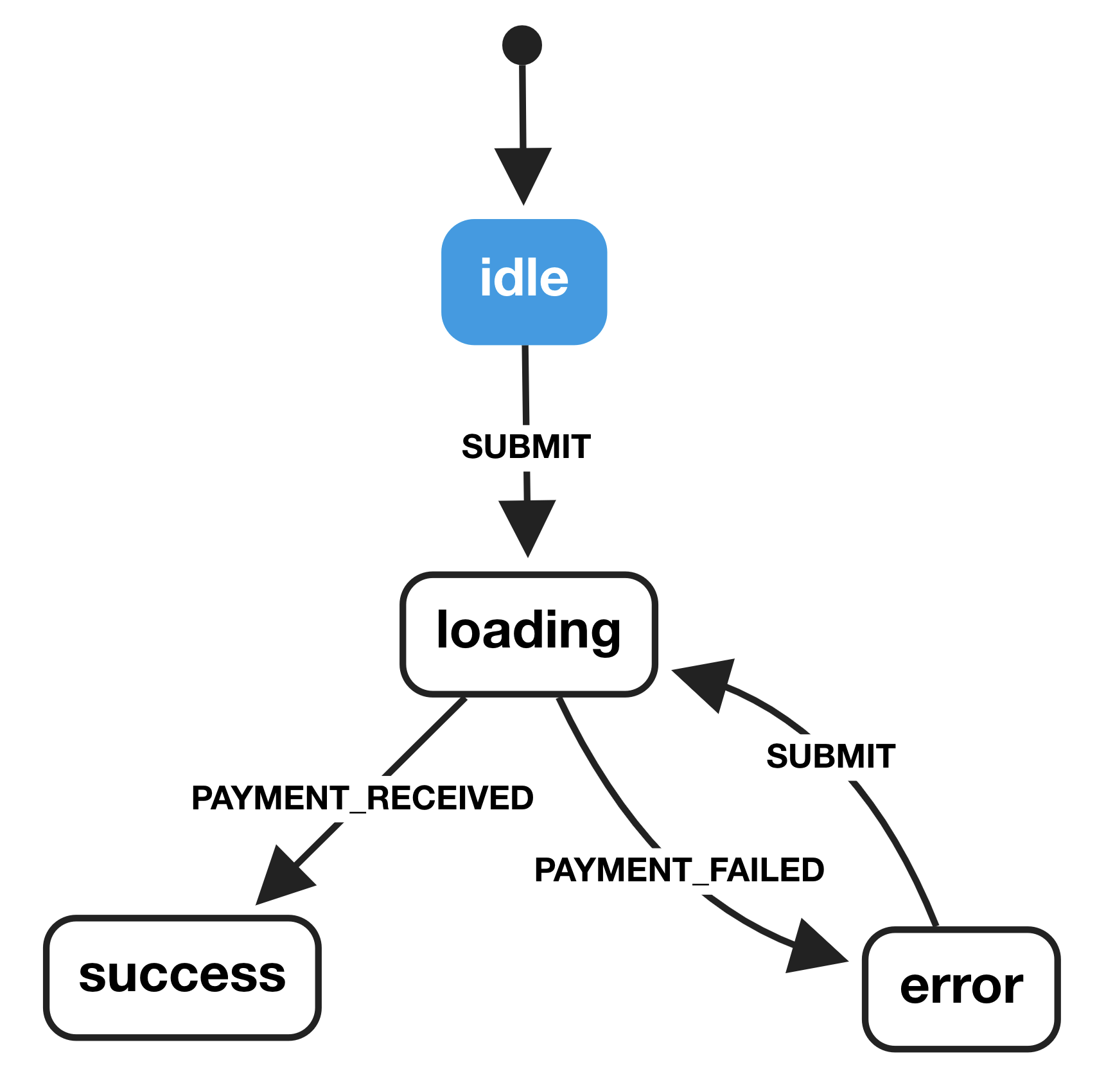
idle;SUBMITmoves toloading; payment completion transitions tosuccess; failures transition toerror; andsuccessis marked as a final state. - XState is stateless in the shown version: The app supplies its current React machine state to
stateMachine.transition(), executes returned actions throughrunActions, then saves the next machine state in component state. - Guards enforce validation: A
condpredicate checks that name and card fields are nonempty before allowing aSUBMITtransition toloading; invalid submissions instead reach or remain inerror. - Visualize and test flows: State-machine diagrams can align stakeholders, while shortest-path analysis can enumerate paths for automatically generated transition and state tests.
Images & Media
- Payment form state diagram — Diagram of
idle,loading,success, anderrorstates and the events connecting them.
Referenced Links
- Promise state-machine implementation — Example of a finite state machine with pending, rejected, and fulfilled states.
- Statecharts paper by David Harel — Foundational 1987 paper introducing statecharts.
- SCXML specification — W3C State Chart XML standard.
- XState — Framework-agnostic JavaScript library used to define and transition the machine.
- XState visualizer (xviz) — Tool for generating and inspecting a state diagram from machine code.
- Payment-form CodePen demo — Demo containing the component markup, styles, and
fakePayment()implementation.