How we index images for RAG
Kapa converts documentation images into text captions at indexing time rather than sending pixels to multimodal models on every query. The approach improves answer quality while adding only 1–6% to per-query cost.
How we index images for RAG
Author: Matteo Bortoletto | Published: 2026-06-01 | Generated: 2026-06-02 | Domain: kapa.ai Tags: ‘#rag’ ‘#multimodal-ai’ ‘#image-indexing’ ‘#technical-documentation’ ‘#retrieval’
TLDR
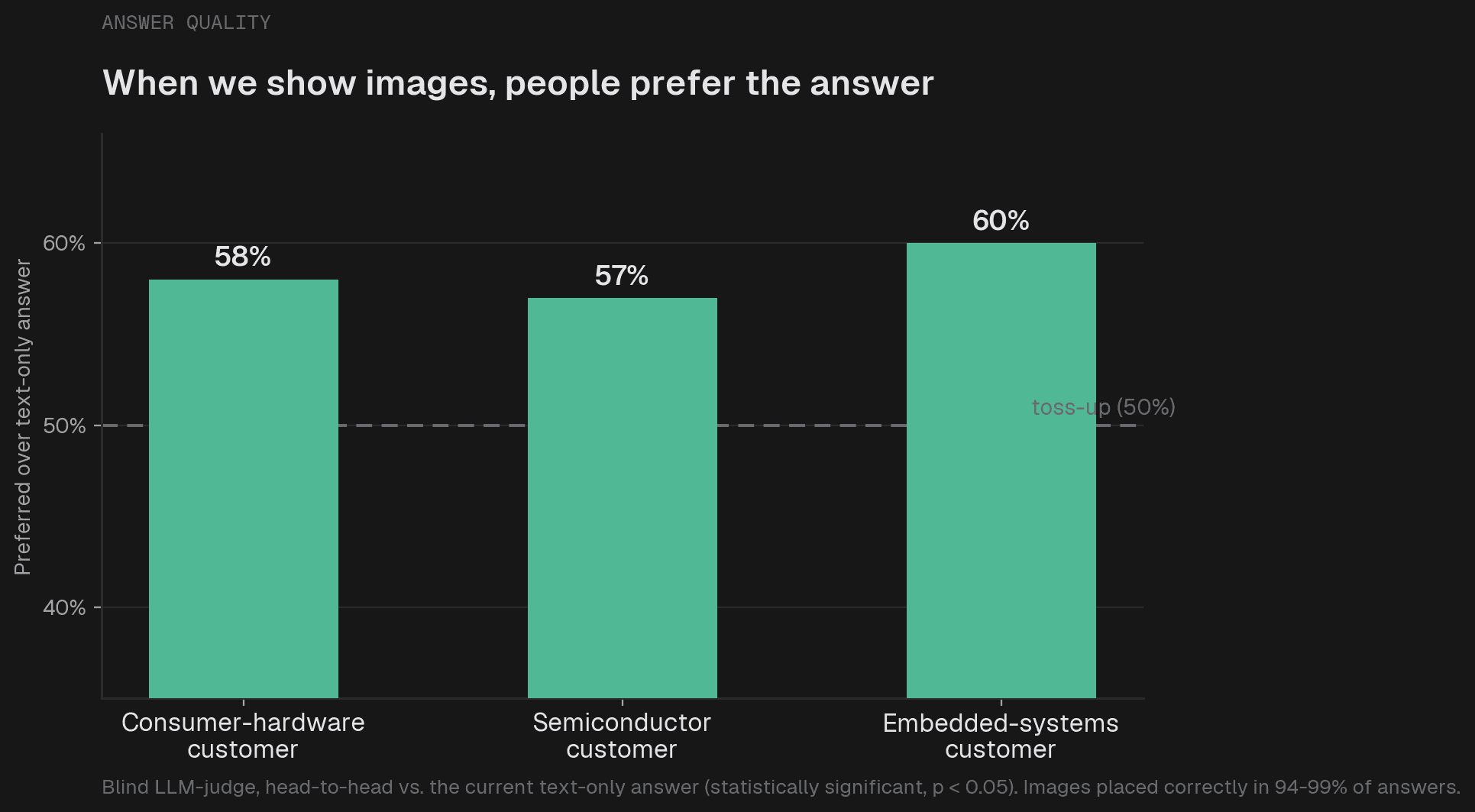
Kapa’s RAG pipeline processes screenshots, diagrams, and tables once during ingestion: a vision-language model produces a textual caption or transcription, which is stored as a separate retrievable chunk alongside documentation text. This avoids the cost, payload limits, and weak fine-grained retrieval of query-time multimodal pipelines while preserving image-derived facts and actionable visual context. Across three customer projects, caption-enabled retrieval significantly improved LLM-judged answer quality at just 1–6% additional per-query cost.
Key Takeaways
- Index images once, retrieve text thereafter: Vision models caption or transcribe each image at ingestion; at query time the LLM receives relevant caption chunks and cites the original image URL without processing raw pixels.
- Query-time multimodal RAG is costly and constrained: Raw images increased per-query cost by 27% with GPT 5.1 and 51% with Claude 4.6 Sonnet; Claude tokenizes an image at roughly 975 tokens, versus GPT’s 716. Typical retrieval references 20–30 images, with a long tail beyond 130, nearing Claude’s 30 MB payload limit at about 25 images.
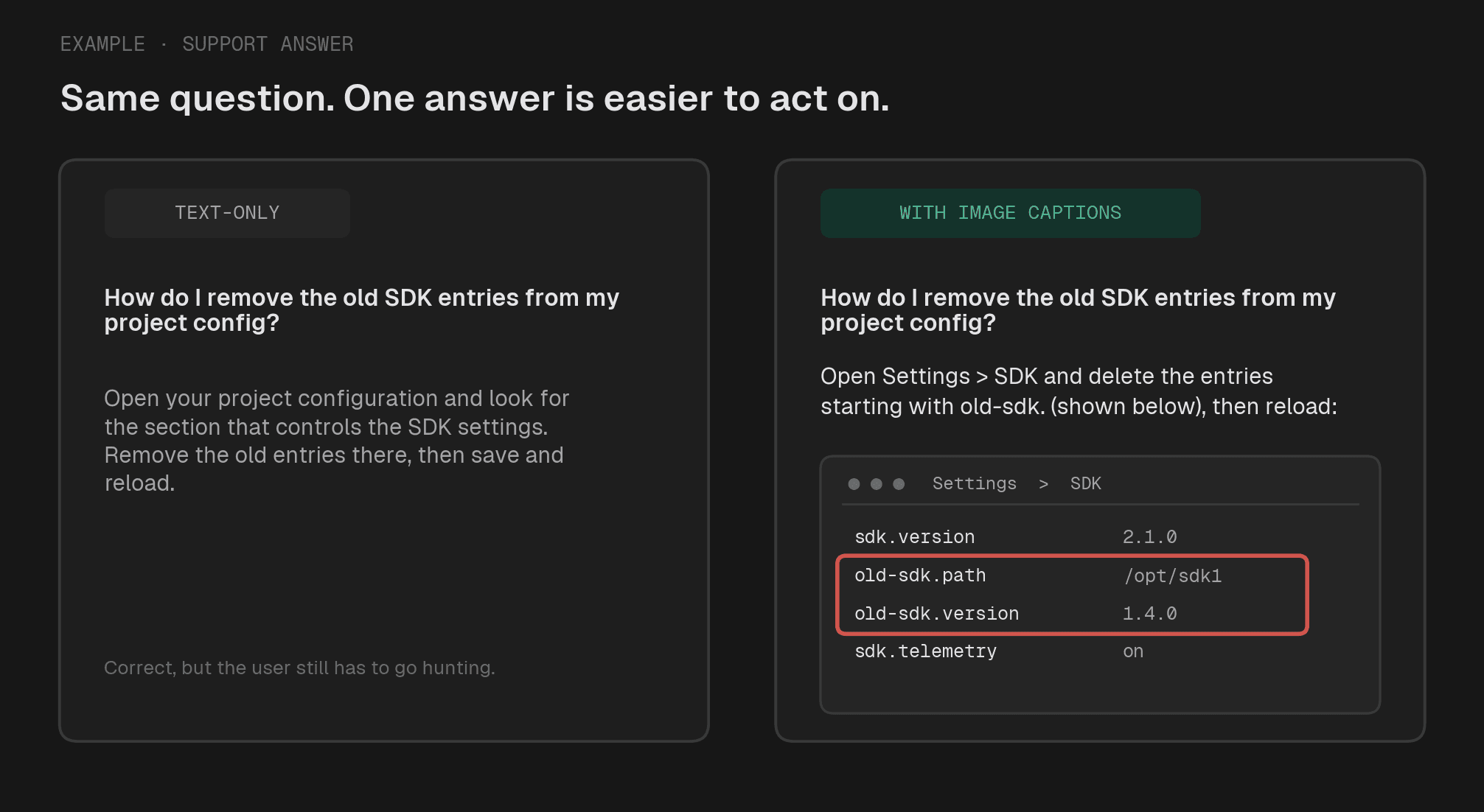
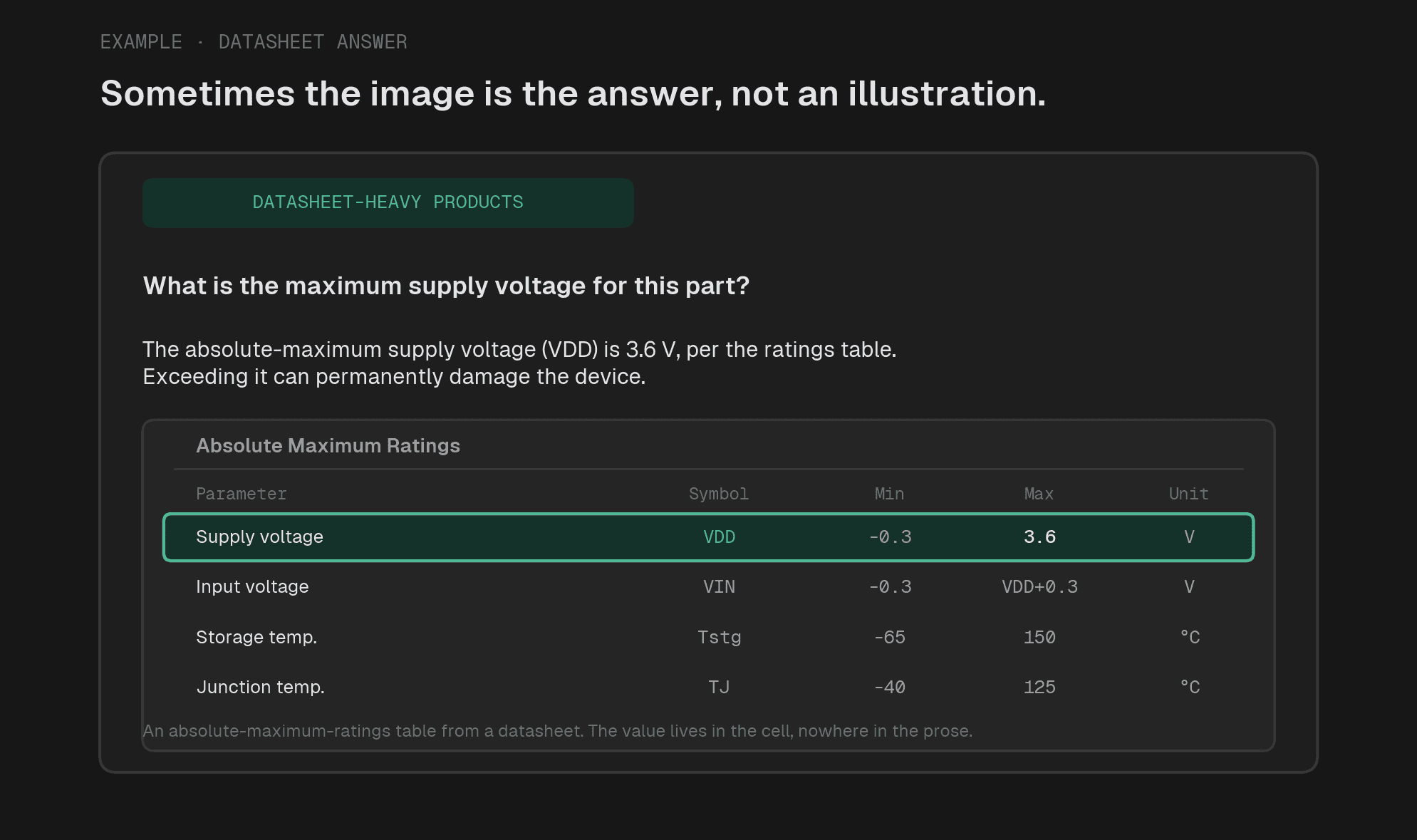
- Captions preserve both illustrative and load-bearing information: Screenshots make instructions more actionable, while transcribed tables, matrices, and schematics expose facts that may exist nowhere in surrounding prose.
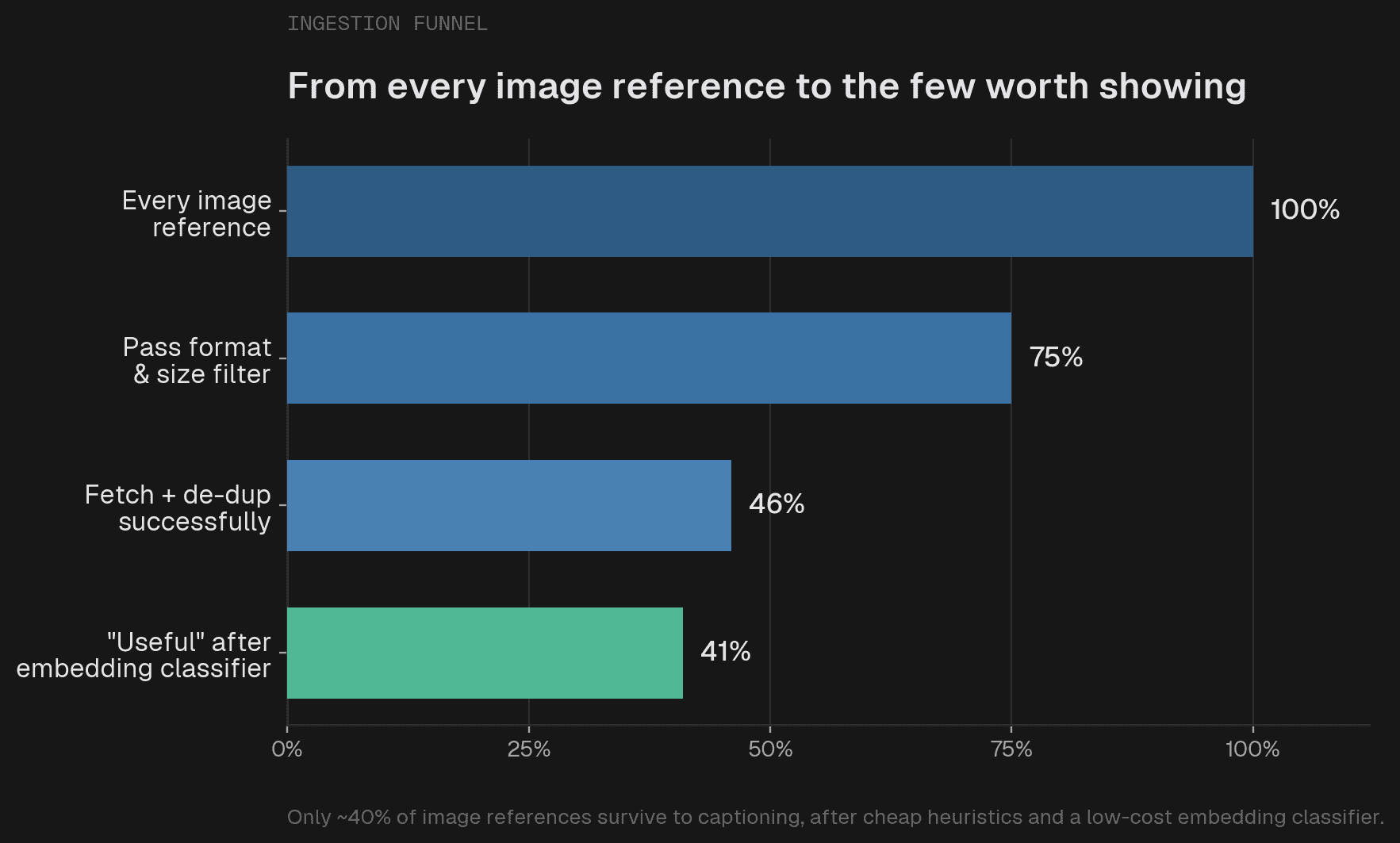
- Filtering needs pragmatic tradeoffs: Heuristics remove unsupported, tiny, or unusually shaped images; a zero-shot multimodal-embedding classifier achieved 96.8% accuracy (F1 0.974) on clear cases and removed about 13% of post-heuristic images, but ambiguous images reached only 59.8% accuracy without textual context.
- Separate caption chunks outperform inline captions: On an image-heavy project, inline captions increased GPT query cost by 19%, versus 6% for separate chunks. Captions reached the reranker’s top 15 on 51% of queries while overall ranking remained stable (Spearman ρ = 0.905); image placement was correct 94–99% of the time.
Images & Media
- Article header illustration — Introductory visual for Kapa’s image-indexing approach.
- Answer comparison screenshot — Contrasts a text-only answer with one that includes an actionable supporting screenshot.
- Image-context quality illustration — Demonstrates how visual context makes support answers easier to follow.
- Load-bearing datasheet figure — Example of a technical figure whose table or diagram content can be the answer itself.
- Image-filtering illustration — Visual context for filtering noise such as logos, banners, and decorative images before captioning.

Referenced Links
- Hacker News discussion — Community discussion of the article.
- Microsoft: Multimodal RAG with Vision — Microsoft research/blog post supporting ingestion-time image description and separate storage.