The Cost of Safetyism
Overprotective parenting has sharply reduced children’s freedom to roam, play, and solve problems independently—despite declining violent crime. Steve Magness argues that replacing manageable risk with constant supervision undermines resilience, agency, and mental health.
The Cost of Safetyism
Author: Steve Magness | Published: 2026-05-19 | Generated: 2026-05-27 | Domain: stevemagness.org
Tags: ‘#parenting’ ‘#child-development’ ‘#autonomy’ ‘#mental-health’ ‘#risk’ ‘#education’
TLDR
Steve Magness argues that a culture of “safetyism”—driven by exaggerated danger perceptions, media exposure, social judgment, and ambiguous neglect laws—has dramatically curtailed children’s independence. Although structural hazards such as car traffic deserve attention, the broader removal of manageable risks and unsupervised play may foster anxiety, learned helplessness, and weaker self-regulation. Parents and coaches should provide security—a dependable base for exploration—rather than attempting to eliminate every discomfort, gradually increasing children’s responsibility and freedom.
Key Takeaways
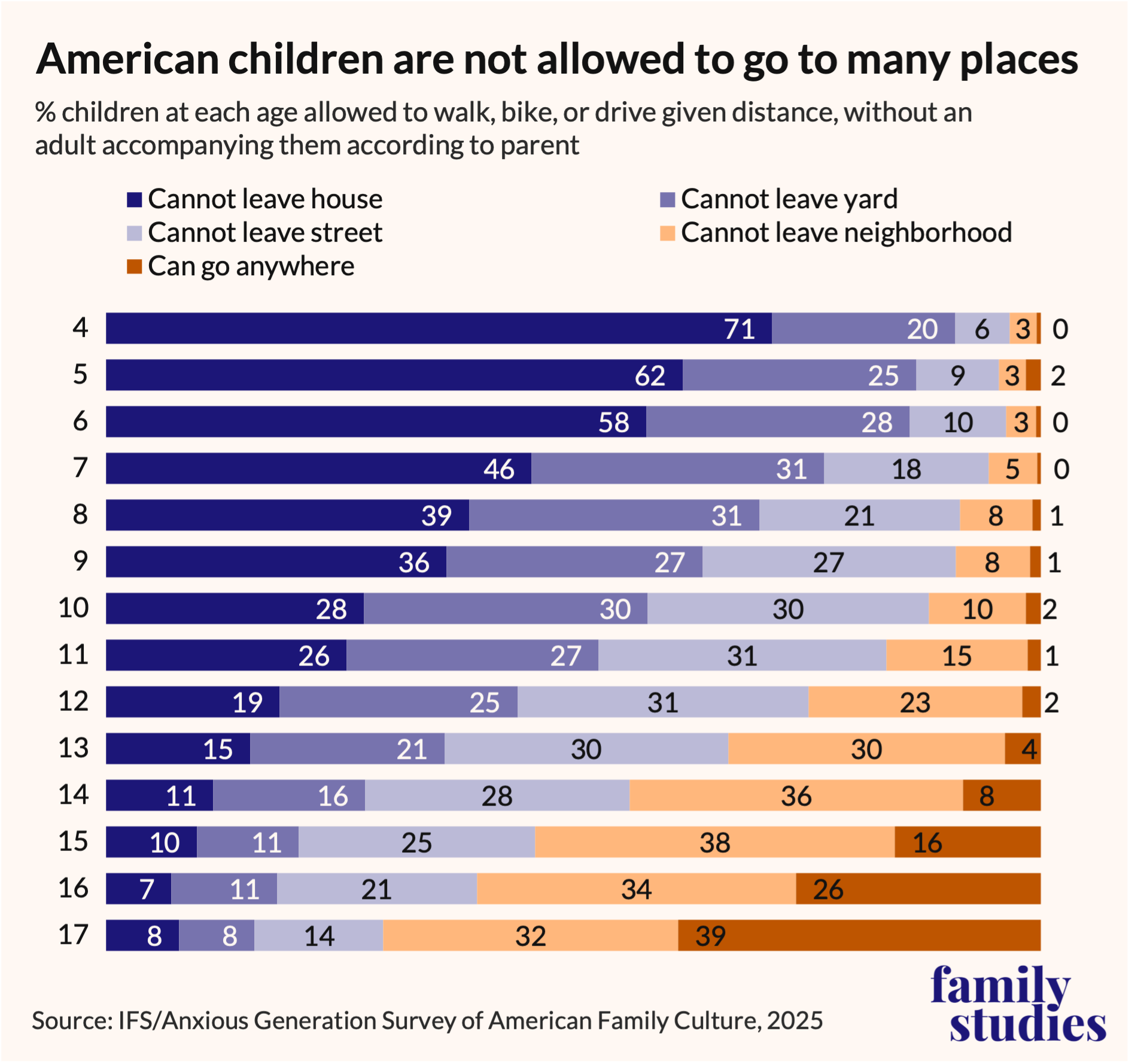
- Children’s freedom has contracted sharply: 84% of 11-year-olds reportedly cannot leave their street and 53% cannot leave their front yard; among 14-year-olds, 92% cannot leave their neighborhood. In England, the share of primary-age children traveling home from school alone fell from 86% in 1971 to 25% in 2010.
- Fear often exceeds objective danger: Violent crime against children has declined since the early 1990s, while media and social-media exposure are associated with greater fear of crime and avoidance behavior. A 2025 study found fear of “stranger danger” more than doubled the likelihood of risk-averse parenting.
- Autonomy is restricted beyond outdoor roaming: Children are also less likely to make snacks, use knives, shop in a separate aisle, or manage other low-stakes tasks—evidence that the issue extends beyond legitimate concerns about traffic or abduction.
- Overprotection carries mental-health costs: A 2020 longitudinal study linked persistently high parental psychological control with worse adolescent depression and anxiety trajectories; a 2024 meta-analysis of 52 studies similarly associated overparenting with depression, anxiety, and internalizing symptoms.
- Security differs from safety: Safetyism seeks to prevent all falls, conflict, and discomfort; security gives children support to recover from mistakes. Age-appropriate free play, conflict resolution, navigation, and risk assessment build intrinsic motivation, resilience, and self-reliance.
Images & Media
- Illustration accompanying “Why the World Shrank” — Visual placed before the article’s discussion of shrinking childhood independence.
Referenced Links
- Nuffield Foundation report on children’s independent mobility — English data on the decline in unaccompanied school travel.
- Media Exposure and Americans’ Perceptions of the World — 2008 study cited on media exposure and perceptions of danger.
- Social media and fear of street violence — Analysis linking social-media use to increased fear of street violence.
- Fear of stranger danger and risk-averse parenting — 2025 study cited on parental restriction of children’s independence.
- Trigger-warning meta-analysis — 2024 review finding trigger warnings offer no benefit and may increase anxiety.
- Overparenting and offspring mental health meta-analysis — Meta-analysis of 52 studies relating overparenting to depression, anxiety, and internalizing symptoms.