How I run multiple $10K MRR companies on a $20/month tech stack
Steve Hanov outlines a deliberately minimal startup stack: a $5–$10 VPS, Go, SQLite, local GPUs for batch AI, and selectively routed frontier models. The aim is to maximize runway and reach product-market fit without cloud complexity or venture-scale burn.
How I run multiple $10K MRR companies on a $20/month tech stack
Author: Steve Hanov | Published: 2026-04-12 | Generated: 2026-04-13 | Domain: stevehanov.ca
Tags: ‘#bootstrapping’ ‘#golang’ ‘#sqlite’ ‘#localai’ ‘#vps’ ‘#saas’
TLDR
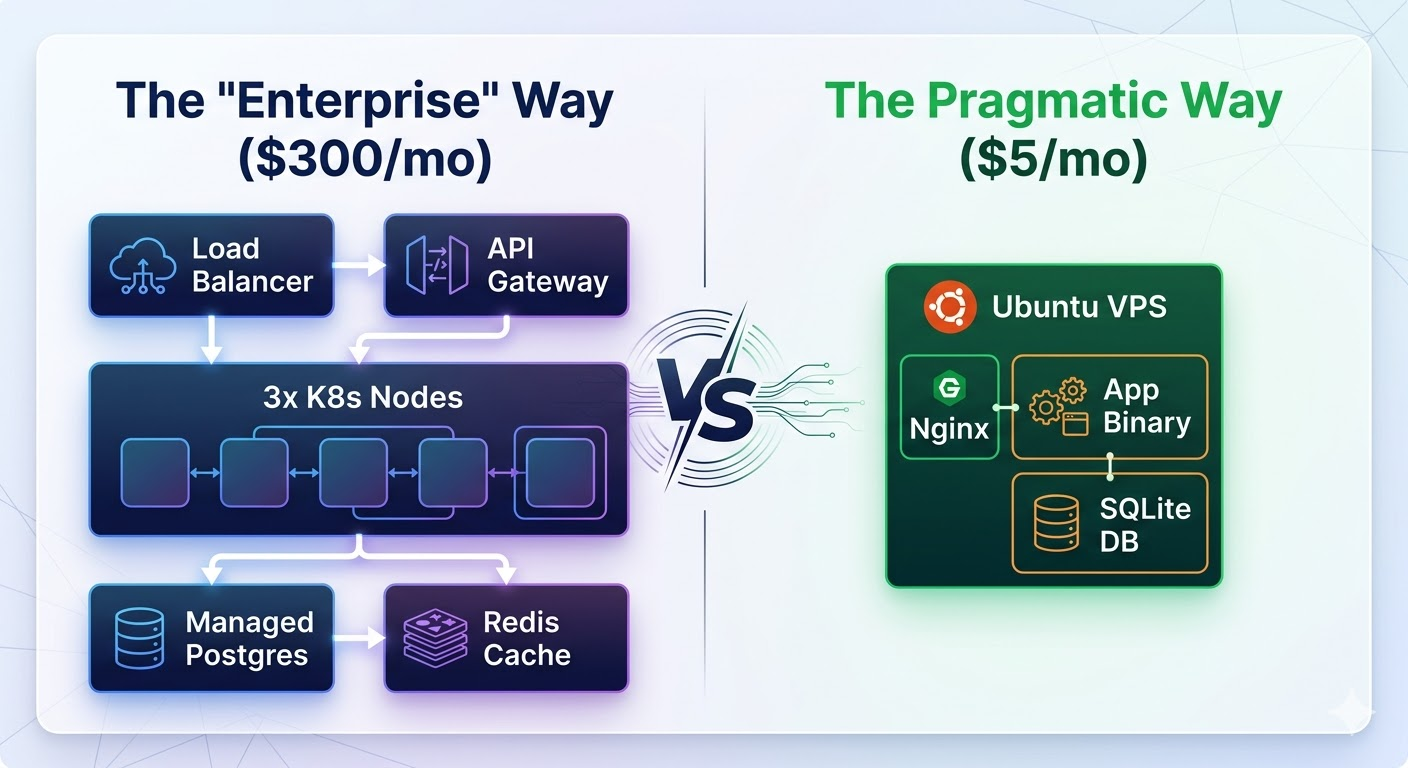
Steve Hanov argues that profitable SaaS products do not need AWS-heavy infrastructure, Kubernetes, or venture funding in their early stages. His lean approach combines a single inexpensive VPS, statically compiled Go services, SQLite with WAL enabled, local GPU inference for batch AI workloads, and OpenRouter for user-facing frontier-model requests. Keeping fixed costs near zero extends runway, simplifies operations, and lets founders focus on product-market fit rather than infrastructure.
Key Takeaways
- A single VPS is enough to start: Hanov recommends a $5–$10/month Linode or DigitalOcean instance; even 1 GB RAM can support a small web product when the stack is kept lightweight.
- Go minimizes deployment and memory overhead: Compile the backend into a single statically linked binary, copy it to the server with
scp, and avoid interpreter, virtual-environment, and dependency-management overhead. - Run batch AI locally: A used RTX 3090 with 24 GB VRAM can eliminate recurring API costs for long-running research and summarization jobs. Start with Ollama for prompt iteration, then use VLLM for higher-throughput production inference through concurrent request batching and PagedAttention.
- Use cloud LLMs selectively through OpenRouter: One OpenAI-compatible integration provides access to major providers and enables fallback routing when a chosen model API is unavailable.
- SQLite is the default database: SQLite avoids a remote database hop and, with
PRAGMA journal_mode=WAL;plusPRAGMA synchronous=NORMAL;, supports concurrent readers alongside writers for many early-stage workloads. - AI coding costs can be constrained: Hanov favors GitHub Copilot in standard VS Code, claiming request-based pricing makes long agentic tasks inexpensive compared with token-priced alternatives.
Images & Media
- Server-resource screenshot — Illustrates the modest resource profile expected from a lean single-VPS setup.
Referenced Links
- WebSequenceDiagrams — Hanov’s web-based sequence-diagram tool, cited as an example of his products.
- eh-trade.ca — Hanov’s niche stock-research product and the motivation for local AI batch processing.
- Transformer Lab — Tool recommended for local model pre-training and fine-tuning.
- laconic — Hanov’s agentic research tool, designed to manage information within an 8K LLM context window.
- llmhub — Library that normalizes local and cloud LLM access through provider, endpoint, and API-key configuration.
- smhanov/auth — Authentication library for signups, sessions, password resets, social login, and SAML.